



The Big Picture
For over a century, competition in the automotive world revolved around engineering better engines, improving fuel efficiency, and scaling manufacturing. Today, those foundations are being rewritten—not only by the shift in how vehicles are powered, but also by how they are built, updated, and experienced.
The first transformation is the emergence of a multi-powertrain future. The narrative is no longer a straightforward transition from internal combustion engines (ICE) to battery electric vehicles (BEVs). Instead, automakers are embracing a portfolio approach that includes hybrids, plug-in hybrids (PHEVs), EVs, hydrogen technologies, and increasingly efficient ICE platforms. The question has shifted from which technology will win to which technology fits which market.
Running alongside this is an equally profound shift: the rise of the Software-Defined Vehicle (SDV). Modern cars are evolving from mechanical machines into intelligent, connected computing platforms. Software, artificial intelligence, cloud connectivity, and over-the-air updates are becoming as important as engines, transmissions, and horsepower, transforming vehicles into products that continue to improve long after they leave the factory.
These developments are deeply interconnected.
Electrification is changing the vehicle’s hardware. Software is redefining its intelligence. Together, they are reshaping every layer of the automotive value chain from semiconductor manufacturers and battery producers to auto-component suppliers, cloud providers, dealerships, insurers, and mobility platforms.
For India, this transformation presents both an opportunity and a challenge. As one of the world’s fastest-growing automobile markets and a global manufacturing hub, the country is uniquely positioned to benefit from this transition. Domestic automakers are expanding their EV and hybrid portfolios, software engineering firms are becoming key partners in the global SDV ecosystem, and India’s auto-component industry is evolving from supplying mechanical parts to producing electronics, powertrain systems, sensors, and intelligent mobility solutions.
In this edition of Industry Pulse, we examine these two defining shifts. Because the future of the automobile industry will not be determined solely by who builds the best car, but by who masters the right combination of powertrain technologies and software capabilities in an increasingly connected, intelligent, and electrified mobility ecosystem.
1. EV Transition Is Becoming a Multi-Powertrain Race:
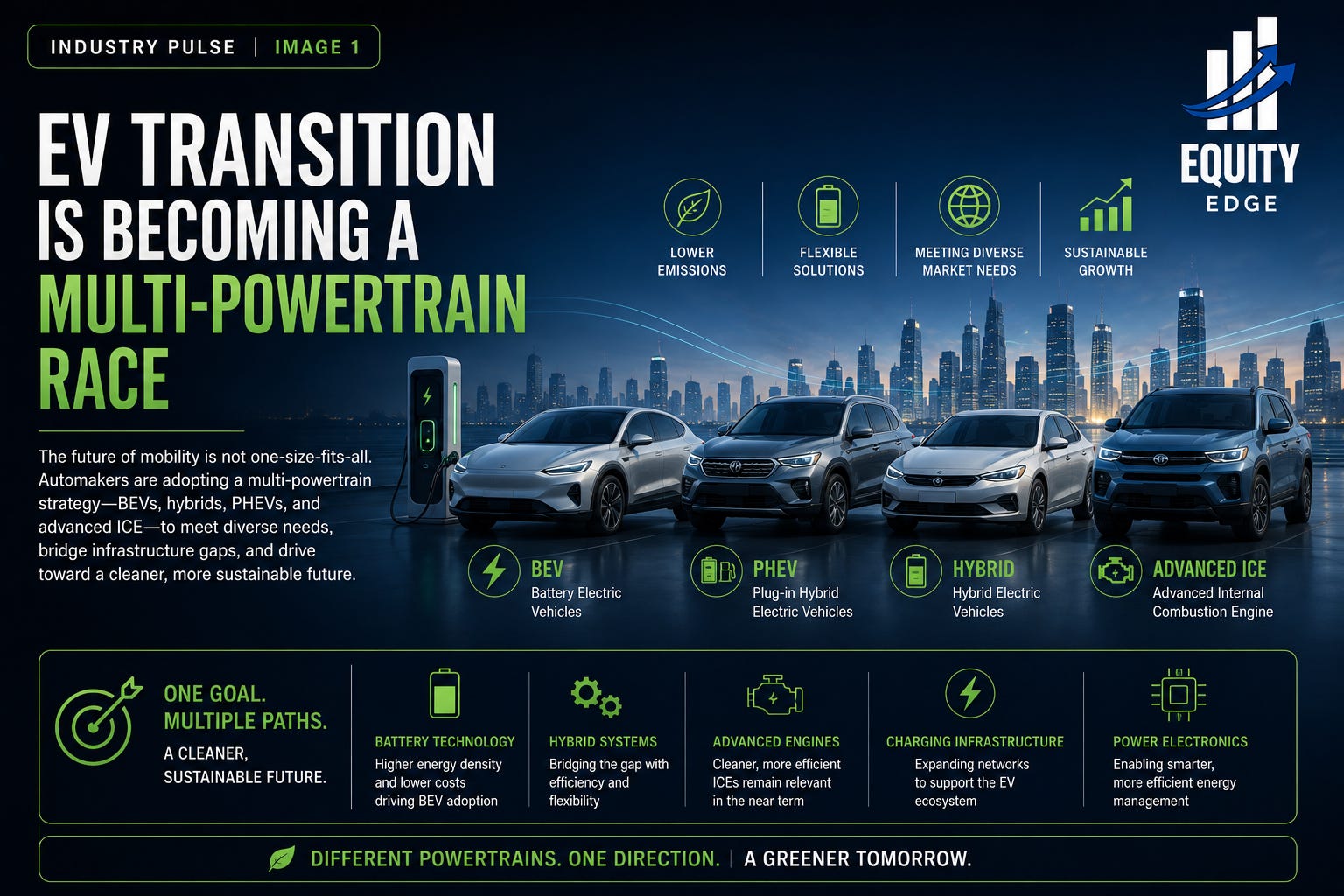
The automobile industry is no longer moving toward a simple internal-combustion engine (ICE) to battery electric vehicle (BEV) transition. Automakers are increasingly pursuing a multi-powertrain strategy that includes BEVs, hybrids, plug-in hybrids (PHEVs), and advanced ICE vehicles, depending on consumer demand, charging infrastructure, regulations, and vehicle segments.
While EVs remain central to the industry’s long-term decarbonization strategy, hybrids are emerging as an important bridge technology by combining the efficiency of electric propulsion with the flexibility of conventional engines. This is creating a more complex competitive landscape where battery technology, hybrid systems, engines, charging infrastructure, and power electronics are all evolving simultaneously.
Major Headlines Related to EV Transition:
I. Global-Specific News
Toyota Plans a Major Expansion of Hybrid Production:
Toyota reportedly plans to increase hybrid and plug-in hybrid production by around 30% to approximately 6.7 million vehicles by 2028, with hybrids potentially accounting for around 60% of its total production, versus roughly 50% in 2026. Toyota has also made its 2026 RAV4 exclusively hybrid/PHEV, eliminating the conventional ICE version in the U.S. market.
Honda Abandons 2030 EV Target After US$9 Billion EV Writedown:
In May 2026, Honda reported its first annual loss since becoming publicly listed, after taking more than US$9 billion in EV-related charges. It scrapped its target for EVs to represent 20% of new-car sales by 2030 and suspended an US$11 billion Canadian EV and battery project. Honda is instead placing greater emphasis on hybrids and other powertrains.
Ford Writes Down US$19.5 Billion and Pivots Toward Hybrids + Affordable EVs:
Ford recorded a US$19.5 billion EV-related writedown and scaled back several large EV programs. At the same time, the company is expanding its hybrid portfolio and developing more affordable EVs, including a planned US$30,000 electric pickup for 2027. Ford expects hybrids and EVs together to account for 50% of global sales by 2030.
Ford’s 2026 results reinforce the strategy: its Bronco and Maverick hybrid models achieved record sales in the first half of the year, even as EV sales declined sharply.
GM Reconsiders LFP Batteries and Shifts Toward Higher-Energy-Density Chemistry:
General Motors is reconsidering its planned use of LFP batteries for future EVs and is instead prioritizing lithium-manganese-rich (LMR) chemistry, which GM believes can offer similar costs with greater energy density. The company is also developing an ecosystem around EVs, batteries and grid integration.
Separately, GM’s renewed partnership with SAIC will target at least 30 electric or hybrid models by 2030, showing that GM’s strategy increasingly spans multiple electrified powertrains.
Chinese Automakers Continue Combining EVs, PHEVs and Hybrid Technology:
Chinese manufacturers are increasingly using multiple electrification technologies to expand internationally. The growing success of BYD, Geely and other Chinese automakers is pushing global manufacturers to respond with broader powertrain portfolios.
A recent example is the Ford–Geely partnership in Europe, where the companies will produce electric SUVs at Ford’s Valencia plant from 2028 and jointly develop a crossover with multiple powertrain options. Meanwhile, SAIC-GM plans at least 30 electric or hybrid models by 2030.
II. India-Specific News:
Mahindra Plans to Double EV Production Capacity:
Mahindra & Mahindra announced in July 2026 that it plans to double its EV production capacity over the next five years, following strong demand for its electric SUVs. Its FY26 annual report also shows that the company expanded capacity for both ICE and electric SUVs, taking operational exit capacity to 64,500 units per month.
Maruti Suzuki Enters India’s EV Market With e VITARA:
Maruti Suzuki began deliveries of its first EV, the e VITARA, in February 2026. The company introduced a Battery-as-a-Service model, with the battery rental component starting at ₹3.99/km, bringing the upfront price of the vehicle down to approximately ₹10.99 lakh.
Toyota Crosses 3 Lakh Hybrid Sales in India:
Toyota Kirloskar Motor crossed the milestone of 3 lakh cumulative hybrid vehicle sales in India in May 2026. Toyota described hybrids as a key part of its multi-pathway approach toward carbon neutrality.
Tata Motors Expands Both EV and ICE Portfolio:
Tata Motors Passenger Vehicles is targeting nearly 2x revenue and volumes by FY31, with sales expected to rise from around 640,000 vehicles to more than 1.2 million. The company plans to invest ₹33,000–35,000 crore across its passenger vehicle and EV businesses between FY26 and FY30, while expanding its portfolio across electric and non-electric powertrains.
Tata Turns to Chinese EV Technology for Its Premium EV Push:
Tata Motors is partnering with China’s Chery to accelerate its premium EV ambitions. Tata plans to use Chery’s Freelander EV platform for its Avinya models, with the first vehicle expected in 2027.
Why Does It Matter?
The automobile industry’s transition is becoming less about replacing ICE vehicles with EVs and more about finding the right powertrain for each market, vehicle segment and consumer. BEVs remain critical to long-term electrification, but hybrids and PHEVs are gaining importance because they offer lower fuel consumption and emissions without depending entirely on charging infrastructure.
This creates a more complex competitive environment for automakers. Companies now need to invest simultaneously in batteries, electric motors, power electronics, hybrid systems and conventional powertrains. The winning technology may therefore vary by geography: BEVs could dominate markets with strong charging infrastructure, while hybrids and PHEVs may remain more attractive in markets where charging availability, vehicle affordability and driving patterns are constraints.
For investors, this matters because the transition is reshaping the entire automotive value chain. It changes which components are required, where capital expenditure is directed, and which suppliers are likely to benefit.
Who Is Doing What?
The multi-powertrain transition is creating different strategies among global and Indian automakers. Some are doubling down on hybrids, others are accelerating EVs, while several are maintaining portfolios across multiple technologies.
Toyota – Betting Heavily on Hybrids:
Toyota has arguably taken the strongest multi-powertrain approach. Rather than relying exclusively on BEVs, the company is aggressively expanding hybrid and plug-in hybrid production while continuing to develop battery EVs.
Toyota’s strategy is based on the idea that different markets will require different powertrains depending on charging infrastructure, electricity availability, consumer economics and regulations.
Honda – Rebalancing Toward Hybrids:
Honda has scaled back its earlier EV ambitions following weaker-than-expected EV economics and is placing greater emphasis on hybrid vehicles.
The company has taken significant EV-related charges and suspended some planned EV investments, demonstrating that automakers are increasingly prioritizing profitability and consumer demand over aggressive EV targets.
Ford – Balancing EVs With Profitable Hybrids:
Ford is pursuing a dual strategy: developing affordable EVs while expanding its hybrid portfolio.
The company has experienced significant losses on its EV programs and is therefore focusing on lower-cost EV platforms and expanding hybrid offerings that can generate stronger near-term economics.
Tata Motors – Expanding Across Powertrains:
Tata Motors is taking a broad approach in India. It remains one of India’s strongest EV players while continuing to invest in ICE vehicles and multiple powertrain technologies.
The company plans significant investment in its passenger vehicle and EV businesses, while its partnership with Chery is expected to accelerate development of premium EVs.
Maruti Suzuki – Entering EVs While Maintaining Diversification:
Maruti Suzuki has entered the BEV market with the e VITARA, but it is not abandoning its existing powertrain strategy.
The company continues to rely heavily on ICE and CNG, while gradually expanding hybrid and EV offerings. This reflects the uncertainty surrounding the pace of mass-market EV adoption in India.
Mahindra & Mahindra – Scaling EVs Alongside ICE SUVs:
Mahindra & Mahindra is taking a more EV-forward approach than many Indian peers, particularly in the SUV segment.
The company is expanding its EV production capacity while continuing to increase its ICE SUV capacity. This gives Mahindra the ability to participate in both the current ICE market and India’s emerging premium EV market.
BYD – Using Multiple Electrified Powertrains to Expand Globally:
BYD has built its competitive advantage around electrification but is not limited to pure BEVs. Its plug-in hybrid DM-i technology allows it to offer long driving ranges while reducing dependence on charging infrastructure.
This is particularly useful when entering markets where public charging infrastructure is still developing.
Second-Order Effects:
Auto-Component Industry Gets More Complex:
The multi-powertrain transition means suppliers cannot assume that ICE components will disappear quickly.
Demand will increasingly be spread across engines, transmissions, electric motors, batteries, inverters, power electronics, thermal management systems and hybrid components.
This could benefit diversified auto-component manufacturers while putting pressure on suppliers heavily dependent on a single ICE component.
Hybrid Components Could Become a Major Growth Segment:
If hybrids remain popular for longer than expected, demand could increase for electric motors, battery packs, inverters, e-axles and hybrid transmission systems without completely eliminating demand for engines.
This creates a potentially attractive “bridge technology” opportunity for component manufacturers.
Battery Demand Will Grow Even Without 100% BEV Adoption:
A multi-powertrain market does not eliminate the battery opportunity.
BEVs require large battery packs, while hybrids and PHEVs require smaller packs. Therefore, even if consumers move toward hybrids rather than pure EVs, demand for battery cells, battery management systems, thermal management and power electronics should continue rising.
Automakers Face Higher R&D and Capital Requirements:
Maintaining multiple powertrain technologies requires companies to invest simultaneously in ICE, hybrid, EV, battery and software platforms.
This could increase capital intensity and make scale increasingly important. Smaller automakers may struggle to economically develop multiple technologies simultaneously.
Supply Chains Become More Strategic:
Automakers will increasingly compete for access to lithium, battery cells, semiconductors, rare earth materials and power electronics, while simultaneously maintaining conventional engine and transmission supply chains.
This could encourage greater vertical integration, localization and strategic partnerships.
India’s Auto-Component Opportunity Could Broaden:
India could benefit from this transition because its component ecosystem is already strong in traditional powertrain manufacturing while gradually expanding into EV motors, battery packs, electronics, precision components and hybrid systems.
Rather than facing an immediate collapse in ICE component demand, Indian suppliers could get a longer transition period to diversify into electrified components.
Key Question
The key question is no longer “Will EVs replace ICE vehicles?”
It is:
Will the global automobile industry eventually converge around BEVs, or will hybrids, PHEVs and other powertrains remain structurally important for much longer than expected?
The answer will determine where automakers allocate hundreds of billions of dollars of future capex, which technologies suppliers invest in, and whether the traditional automotive value chain is disrupted gradually or rapidly.
For investors, the bigger question is which companies can remain profitable across multiple powertrain cycles rather than betting everything on a single technology.
2. The Car Is Becoming a Software-Defined Vehicle:
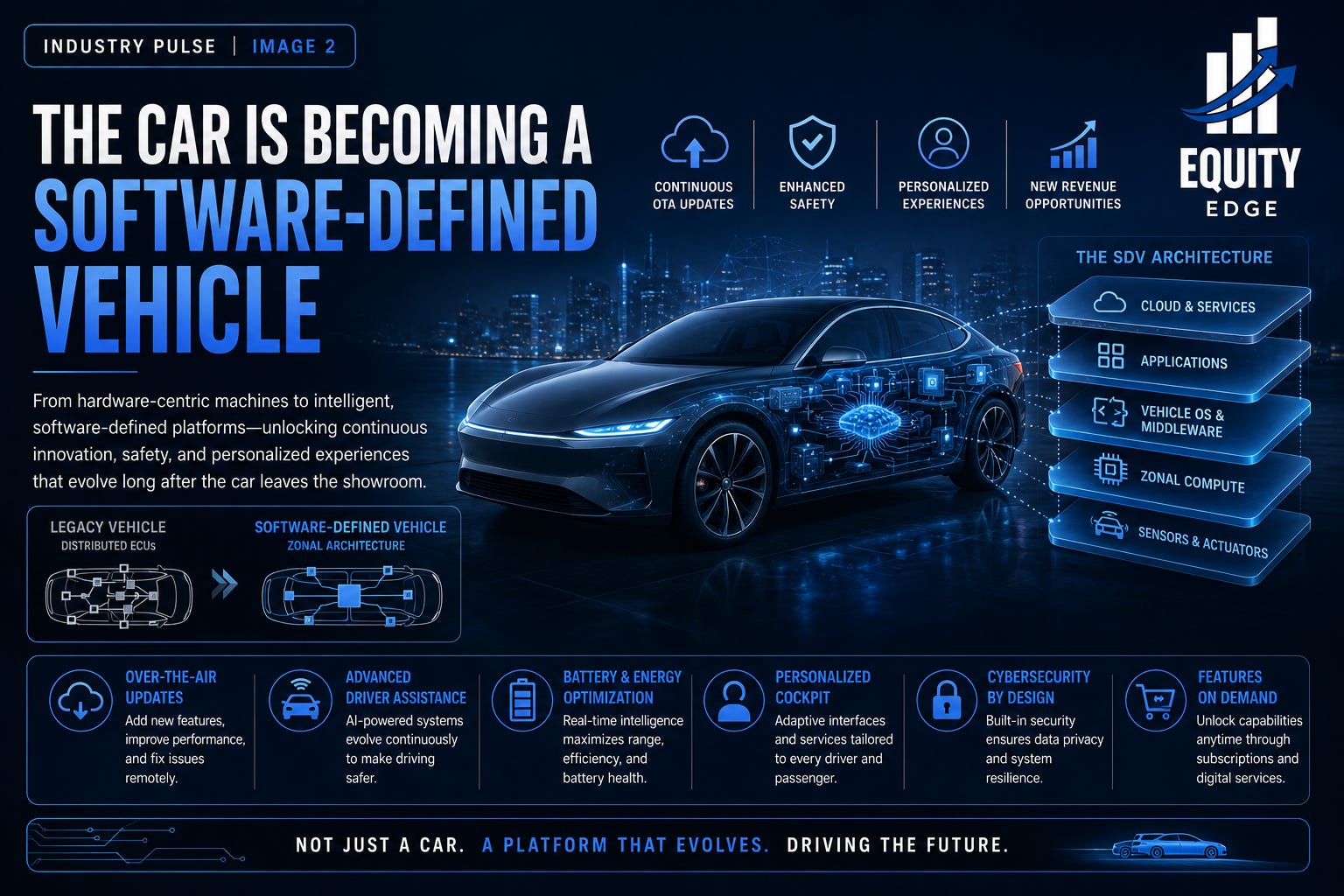
The automotive industry is undergoing its most radical architectural pivot since the invention of the assembly line: the transition from hardware-centric mechanical machines to Software-Defined Vehicles (SDVs). For over a century, a car’s capabilities, performance, and feature set were locked in the moment it rolled off the factory floor. Today, modern vehicles are evolving into high-performance, edge-computing data centers on wheels, where software code, rather than physical horsepower, defines the driving experience, safety protocols, and long-term asset value.
This transformation is fundamentally decoupling hardware development from software release cycles. By shifting away from legacy, fragmented networks of dozens of isolated Electronic Control Units (ECUs) toward centralized zonal computing architectures, automakers can update, manage, and continuously upgrade vehicle functionality over-the-air (OTA). From real-time battery optimization and advanced driver-assistance systems (ADAS) to personalized cockpit experiences, the car is transitioning from a static physical product into a dynamic, evolving digital platform.
The economic implications of this shift are rewriting the rules of automotive manufacturing, technology partnerships, and consumer ownership. Software is becoming the primary driver of competitive differentiation and post-sale monetization through recurring digital subscriptions and feature-on-demand services. As automakers race to master complex vehicle operating systems, cloud-to-car middleware, and cybersecurity assurance, the SDV revolution is forcing legacy OEMs to operate more like tech platforms, permanently altering the mobility ecosystem.
Major News Related to Software-Defined Vehicles
I. India-Specific News
Tata Elxsi Partners with Autolink at CES to Drive Global SDV Platforms:
Tata Elxsi announced a strategic partnership with Autolink to accelerate the adoption of Software-Defined Vehicle (SDV) architectures for global OEMs. By integrating Tata Elxsi’s AVENIR SDV software platform with Autolink’s intelligent cockpit-driving fusion domain controllers, the collaboration provides automakers with open, cloud-native middleware, containerized OTA frameworks, and centralized E/E architectural tools to streamline vehicle software development.
Mahindra and Tata Motors Scale Zonal Architectures Across EV Lines:
Leading Indian automakers, including Mahindra & Mahindra and Tata Motors, are transitioning away from distributed, single-function ECUs toward centralized zonal computing platforms. By leveraging high-performance automotive platforms, such as Qualcomm’s Snapdragon Digital Chassis, domestic OEMs are deploying real-time cloud analytics, high-definition digital cockpits, and scalable Level 2+ ADAS across their newest electric SUV portfolios.
India Hosts Flagship SDV Summit in Pune to Target Global Automotive Tech:
Bringing together domestic engineering leaders, policymakers, and global tech providers, the flagship SDV Summit in Pune highlighted India’s expanding role as a global R&D hub for vehicle software. The summit focused on establishing standardized automotive operating systems, open-source middleware (such as SOAFEE), localized V2X communication standards, and robust cybersecurity frameworks for connected vehicles.
II. Global-Specific News
Qualcomm Unveils Snapdragon Cockpit Elite and Ride Elite Platforms:
Qualcomm expanded its Snapdragon Digital Chassis portfolio with the introduction of its next-generation Snapdragon Cockpit Elite and Snapdragon Ride Elite platforms. Designed specifically for high-throughput AI workloads and centralized compute architectures, these high-performance chips allow automakers to run digital cockpit applications, multi-camera ADAS algorithms, and generative AI copilots simultaneously on a single system-on-chip (SoC).
Volkswagen Group and Qualcomm Sign Joint SDV Architecture Agreement:
Volkswagen Group’s software arm, Cariad, signed a strategic agreement with Qualcomm to integrate Snapdragon Digital Chassis technologies across next-generation vehicle brands. The partnership focuses on accelerating cloud-to-car software deployment, establishing unified vehicle operating systems, and enabling post-purchase feature-on-demand capabilities via over-the-air (OTA) updates.
NVIDIA Scales DRIVE Thor for Generative AI and Autonomous Driving:
NVIDIA accelerated the deployment of its DRIVE Thor centralized automotive supercomputer, designed to deliver over 2,000 TOPS (Tera Operations Per Second) of compute power. Early adopting OEMs, including BYD, Volvo, and Geely, are utilizing the platform to run end-to-end neural networks for autonomous driving, localized large language models (LLMs) for conversational in-cabin avatars, and continuous synthetic data validation.
Global Auto Industry Standardizes on Android Automotive OS (AAOS) and Open Middleware:
Major global vehicle manufacturers are moving away from proprietary, in-house infotainment operating systems in favor of Google’s Android Automotive OS (AAOS) paired with open-source middleware frameworks. This industry-wide standardization enables cloud-native app ecosystems, seamless developer integration, and cloud-to-vehicle simulation environments that compress software release timelines.
Why Does It Matter?
The transition to Software-Defined Vehicles matters because it fundamentally changes the vehicle ownership lifecycle, auto manufacturing economics, and mobility safety. For decades, a car was a depreciating physical asset that hit its peak functional performance the day it left the dealership lot. In the SDV era, continuous cloud connectivity and over-the-air (OTA) updates allow vehicles to receive continuous feature upgrades, performance enhancements, and safety patches throughout their operational life, turning the car into an evolving digital platform.
This architectural shift dismantles the legacy automotive model of relying on dozens of isolated, single-function Electronic Control Units (ECUs) supplied by disparate tier-1 vendors. By consolidating vehicle computing into centralized domain controllers and zonal architectures, automakers can drastically cut physical wiring harness weight, reduce manufacturing complexity, and shorten product development cycles from five years down to months.
To understand why this paradigm shift is reshaping the industry, consider these concrete real-world impacts:
Preventing Costly Physical Recalls via Over-the-Air Updates: Traditionally, resolving a software glitch or safety bug required scheduling dealership appointments, resulting in massive logistical costs and brand damage. With SDV architectures, OEMs deploy critical system patches, braking recalibrations, and safety fixes overnight to millions of vehicles simultaneously via secure OTA channels.
Creating Post-Purchase Monetization and Feature-on-Demand Models: Beyond upfront sticker prices, automakers are unlocking high-margin recurring revenue through digital subscriptions. Vehicle owners can unlock advanced self-parking, enhanced battery range, adaptive suspension modes, or high-definition streaming packages on demand via in-cabin app stores.
Accelerating Continuous Active Safety and Autonomous Driving: Centralized computing platforms continuously process sensor data from cameras, radar, and LiDAR in real time. As autonomous driving models improve through fleet-wide machine learning operations (MLOps), vehicles can receive updated Level 2+ and Level 3 driver-assist capabilities overnight without changing physical hardware.
From an economic perspective, SDVs shift auto manufacturing toward software-like profit margins and data-driven business models. Market estimates project that software, connected services, and feature-on-demand subscriptions will generate hundreds of billions of dollars in recurring value for automakers by the 2030s. This forces traditional OEMs to restructure their engineering workforces, moving away from pure mechanical engineering toward cloud software engineering, cybersecurity management, and continuous AI delivery.
Who Is Doing What?
The transition toward Software-Defined Vehicles is being driven by global semiconductor leaders, automotive software powerhouses, legacy OEMs, and specialized engineering partners, each building the foundation for cloud-connected, software-driven mobility:
Qualcomm (Powering the Centralized Silicon Foundation):
Qualcomm is establishing itself as the primary silicon backbone for modern vehicle architectures through its Snapdragon Digital Chassis suite. By providing unified compute platforms, such as the Snapdragon Cockpit Elite and Snapdragon Ride Elite, Qualcomm enables automakers like BMW, Mercedes-Benz, and Volkswagen Group to consolidate digital cockpits, automated driving stack execution, and cloud connectivity into high-performance, single-chip solutions.
Tesla (Setting the Benchmark for Vertically Integrated SDVs):
As the early pioneer of full-stack software integration, Tesla maintains an industry benchmark with its vertically integrated E/E architecture, proprietary vehicle operating system, and centralized domain compute. Tesla continuously deploys fleet-wide over-the-air (OTA) software releases, continuously upgrading its Full Self-Driving (FSD) neural network models, cabin infotainment features, and thermal management efficiency without physical hardware alterations.
Tata Elxsi & Indian Engineering Tech (Accelerating Cloud-to-Car Middleware):
Global engineering and software service providers based in India, including Tata Elxsi, KPIT Technologies, and Tata Technologies, are developing open-source middleware, containerized OTA frameworks, and simulation platforms. Tata Elxsi’s AVENIR platform allows global OEMs to decouple underlying vehicle hardware from upper-layer application software, significantly accelerating development timelines for global automakers.
Bosch & ETAS (Standardizing Vehicle Operating Systems and Middleware):
Global Tier-1 supplier Bosch, alongside its software subsidiary ETAS, is building modular software development factories and cloud middleware platforms. By focusing on standardized vehicle basic software, cybersecurity stacks, and AUTOSAR execution environments, Bosch enables legacy automakers to transition smoothly from legacy distributed ECUs to modern zonal computing architectures.
Google & Apple (Dominating the In-Cabin Digital Experience):
Tech platforms Google and Apple are competing to control the digital cockpit. Google’s native Android Automotive OS (AAOS) is being directly embedded by OEMs like Volvo, Ford, and GM to power connected infotainment platforms, while Apple continues expanding its next-generation CarPlay framework to take over multi-screen dashboard displays across modern vehicle lineups.
Second-Order Effects:
The transition toward Software-Defined Vehicles is expected to create significant ripple effects across industries beyond traditional automotive manufacturing.
Structural Reorganization of Tier-1 Automotive Supply Chains:
As automakers transition to centralized zonal architectures and open-source middleware, traditional Tier-1 suppliers are seeing their margins squeezed on legacy physical components. Hardware suppliers are forced to pivot into pure software development, cybersecurity compliance, and modular cloud services, leading to consolidation, joint ventures, and direct competition with non-traditional technology vendors.
Radical Shift in Usage-Based Auto Insurance & Risk Underwriting:
Always-on connectivity and continuous vehicle telematics allow insurance companies to move away from static, demographic-based risk models. Insurers can evaluate real-time driving behavior, autonomous feature utilization, and active safety interventions, creating dynamic pay-how-you-drive premium pricing and shifting liability toward software developers when autonomous systems are engaged.
Transformation of the Automotive Aftermarket & Independent Repair Workshops:
Traditional mechanics and local repair shops face major technological hurdles as physical repairs are replaced by software diagnostics, encrypted code, and proprietary cloud authentication. Independent workshops are forced to invest heavily in advanced diagnostic hardware, software certification, and cybersecurity training, while OEMs capture a larger share of post-sale maintenance through predictive remote diagnostics.
Resale Value Stabilization and Extended Fleet Lifespans:
Unlike legacy automobiles that suffer from rapid depreciation as physical features age, SDVs can receive functional upgrades long after leaving the factory floor. Continuous over-the-air updates for infotainment, battery management, and driver assistance extend the operational lifespan of pre-owned vehicles, stabilizing long-term residual values and transforming secondary market dynamics.
Surge in Demand for Automotive Semiconductor & Cybersecurity Infrastructure:
The shift toward high-performance centralized computing is driving exponential demand for automotive-grade silicon, high-capacity memory chips, and cloud hosting infrastructure. Concurrently, as vehicles become connected edge endpoints vulnerable to remote cyberattacks, automakers and fleet operators are committing significant capital expenditure to end-to-end encryption, continuous threat monitoring, and zero-trust security architectures.
Key Question
The long-term realization of Software-Defined Vehicles will depend less on proving software-driven capabilities and more on whether traditional automakers can successfully execute the organizational, architectural, and business-model shifts required to compete with native tech platforms.
Can legacy automakers overcome decades of entrenched mechanical engineering processes and fragmented supplier ecosystems to master complex cloud-native software development? Will consumers accept ongoing subscription fees for digital features, and can OEMs secure these connected platforms against increasingly sophisticated cyber threats
Sources: Tata Elxsi Press Releases, Qualcomm Snapdragon Summit Newsroom, Volkswagen Group & CARIAD Announcements, NVIDIA DRIVE News, Automotive News (SDV & E/E Architectures), SAE International, and ET Auto.