We Provide More Such Industry Reports with Deeper Insights in Our Premium Services. The Customers are Happy with our Work. Reach out to us through Email to Avail them!
Introduction
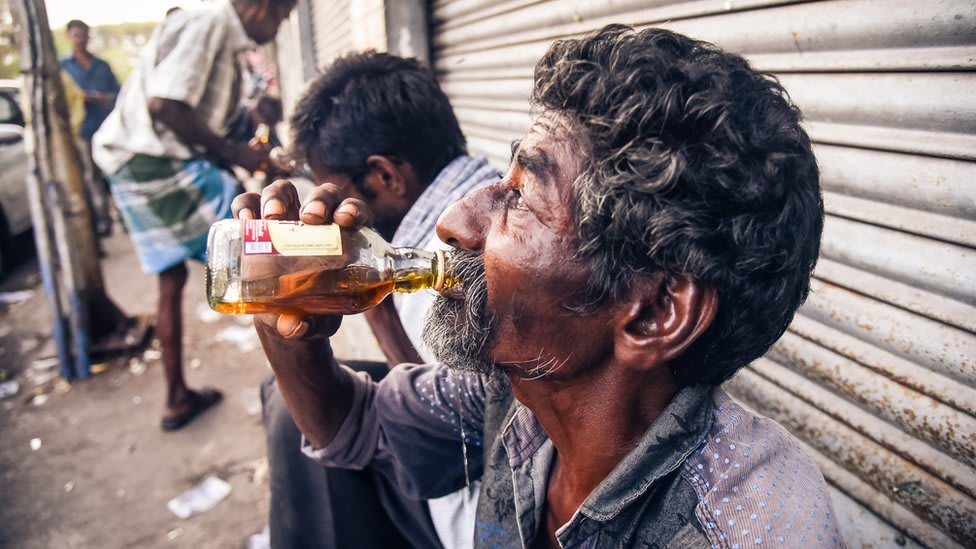
Today's lesson might just make you the most interesting person at your next dinner party. We’re diving into the alcohol industry.
Now, when you hear alcohol, your brain might jump to parties, clinking glasses, or that awkward office mixer. But behind the buzz is a fascinating world of economics, culture, chemistry, and cutthroat business. This is one of the oldest industries in human history — we’re talking ancient Egypt, Mesopotamia, even Vedic India — where fermentation was practically an early science experiment and a social ritual rolled into one.
Fast forward to today, and the alcohol industry is a multi-billion-dollar global machine. It spans everything from heritage-rich vineyards in France to bustling breweries in Bangalore, to clever startups making gin out of seaweed or whiskey aged in space (yes, really).
In India, this sector is especially quirky. It’s heavily regulated, state-controlled, wildly profitable — and also considered a bit taboo in certain circles. Imagine selling a product that’s in huge demand, but can’t be advertised on TV. That’s the paradox the alcohol biz lives in.
Shall we raise our curiosity glasses and begin?
1. Global Snapshot of the Industry
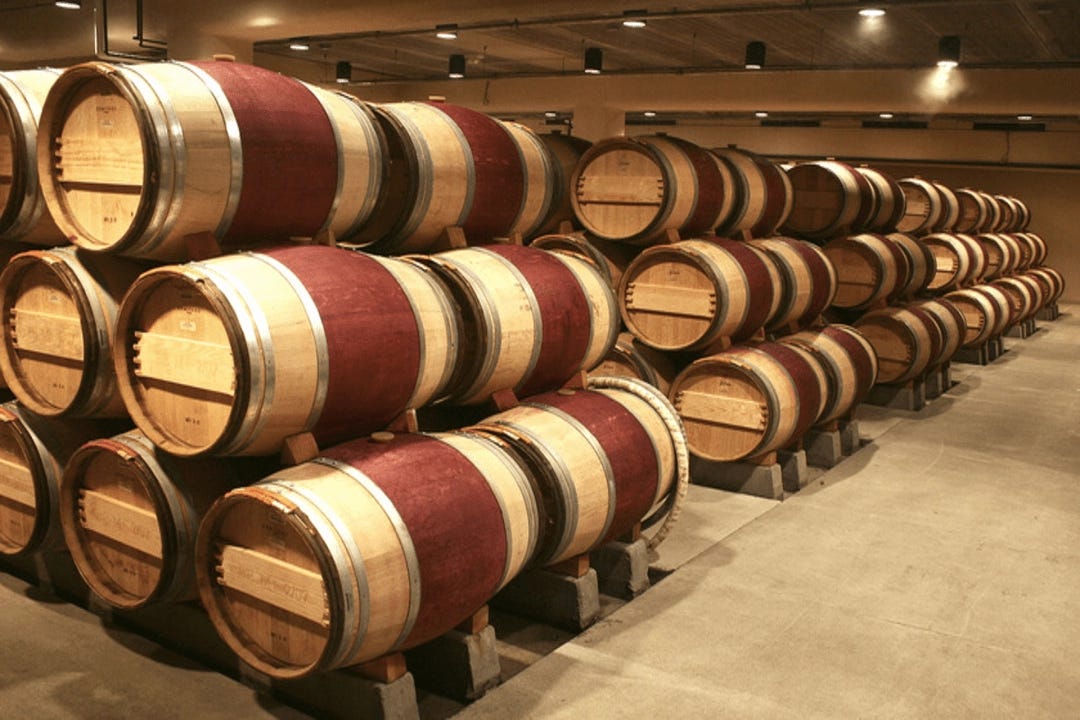
As of March 2025, projections show that the global alcoholic drinks market is set to continue its upward trajectory, growing steadily from 2024 through 2028.
Over this five-year span, the market is expected to expand by USD 384.4 billion, marking a 22.4% increase. By 2028, total market revenue is anticipated to hit a new all-time high of USD 2.1 trillion, extending its growth streak to eight consecutive years.
Key Regional & Segment Insights
China leads the global market in alcoholic beverage revenue, generating over USD 335 billion annually.
The United States follows as the second-largest market, with USD 286 billion in yearly revenue.
Within product categories:
Spirits (e.g., whisky, vodka, rum, gin, tequila) dominate globally with approximately USD 531 billion in revenue.
Wine contributes around USD 265 billion, with the U.S. leading at USD 58 billion, followed by:
France at USD 26.7 billion
China close behind at USD 26.4 billion
Key Segments:
Beer: Mass-consumed, relatively low-margin but high-volume. Includes Alcoholic and Non-Alcoholic options, the latter gaining traction for health-conscious consumers.
Spirits: Premium positioning and higher margins. Includes categories like Whisky, Vodka, Rum, Gin, Brandy, Soju, Tequila, and Liqueurs. Driven by aspirational consumption and premiumization trends.
Wine: Mid-to-premium category. Segmented into Still (Red, White, Rosé), Sparkling, and Fortified Wine. Sparkling and rosé wines show strong growth in urban markets.
Cider, Perry & Rice Wine: Niche but growing, especially in health-conscious and experimental consumer segments.
Hard Seltzer: Fast-emerging segment with appeal to Gen Z and millennials. Combines low-calorie positioning with lifestyle branding.
Major Global Players
Anheuser-Busch InBev – High-volume brands like Corona, Bud Light, Michelob.
Diageo – Strong presence in premium spirits with brands like Johnnie Walker, Guinness, Tanqueray.
Heineken – Global beer leadership with increasing focus on low-alcohol and craft.
Molson Coors – Broad North American presence, pivoting into hard seltzers and innovation-led growth.
2. India: Too Drunk?
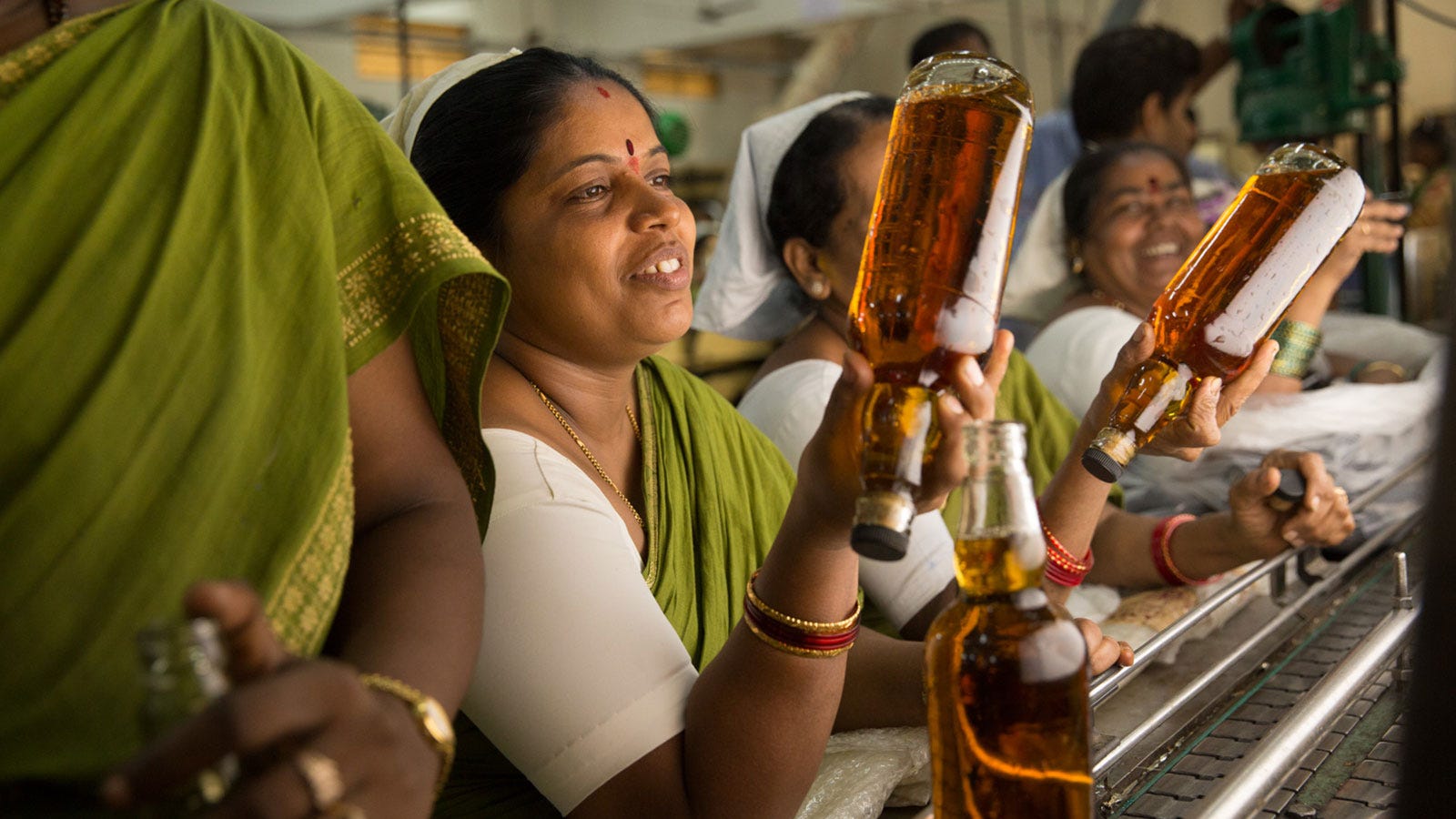
India’s alcohol industry is booming—and it’s not just about people drinking more. Tastes are changing, new trends are emerging, and the market is growing fast.
1.1 Big Numbers, Bigger Growth
India’s alcohol industry is on a steady growth path. It’s expected to be worth $200 billion in 2025, and by 2035, that number could reach $300 billion, growing at a rate of 7.2% per year. Between 2020 and 2025, it grew at 6.8%, so the pace is picking up.
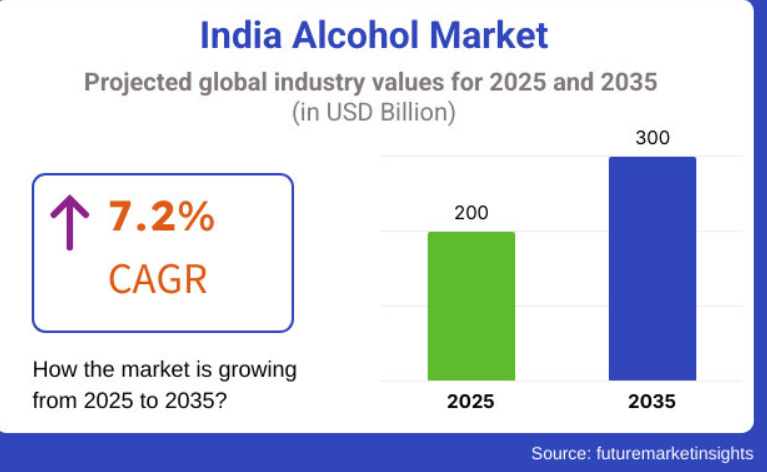
After a dip during COVID-19, sales bounced back strongly. For example, IMFL (Indian Made Foreign Liquor) sales hit 385 million cases in 2023—higher than the 355 million in 2020. That shows strong demand is here to stay. futuremarket and coherentmarket
1.2 State-Wise Highlights: Who’s Drinking, Who’s Growing?
Not all states sip the same. Let’s break down where India’s alcohol market is really pouring from.
Maharashtra: The Big Boss of Booze
With bustling metros like Mumbai and Pune, Maharashtra is the heavyweight of India’s alcohol industry.
A fast-growing urban population and a culture that doesn’t shy away from a drink make it a top consumer.
The state has it all: distilleries, breweries, liquor stores, bars, restaurants, and a nightlife that caters to every kind of drinker—from the occasional beer sipper to the whisky aficionado.
That solid infrastructure has made Maharashtra a powerhouse of production and consumption.
Goa: The Party Capital That Keeps on Pouring
Goa isn’t just India’s holiday playground—it’s also an alcohol growth engine.
Why? Tourists, beach bars, low taxes, and long happy hours.
From beach shacks to swanky clubs, Goa’s alcohol culture is booming thanks to liberal policies and a steady stream of visitors (both Indian and international).
With more locals earning well and spending on leisure, there’s a growing taste for premium and imported drinks—both alcoholic and non-alcoholic.
In short:
Maharashtra leads with scale and infrastructure.
Goa wins with vibes, tourism, and easy-going laws.
The future of India’s alcohol industry? It’s sparkling—and these states are leading the toast. futuremarket
1.3 Per Capita Consumption and Growth Potential
Even with this growth, India’s alcohol consumption per person is still low compared to the global average. That means there’s still a lot of room for the market to expand.
Every year, around 13 million more people become old enough to drink. Add to that a growing middle class with more money to spend—the average household income went from $1,100 in 2010 to nearly $1,800 in 2020—and you get a recipe for rising demand, especially for premium products. coherntmarket
3. Key Industry Trends Shaping India’s Alcohol Market
India’s alcohol scene is no longer just about quantity—it’s about quality, choice, and changing mindsets. Here's what’s shaking (and stirring) the market:
1. Premiumization: Consumers Trading Up
There is a growing shift from value-focused brands to premium alcoholic beverages, especially in urban areas. Consumers—particularly in Tier 1 and Tier 2 cities—are becoming more brand-conscious and willing to spend more for higher quality products.
This trend is especially visible in segments like Scotch whisky and white spirits (such as vodka and gin), where premium and imported brands are gaining popularity.
2. Changing Spirit Preferences: Rise of White Spirits
While traditional brown spirits like whisky, rum, and brandy still dominate, white spirits are gaining ground. Urban consumers are experimenting more, driven by the rise of cocktail culture and interest in new drink experiences.
Brands are responding by introducing innovative flavors and premium offerings in categories like gin and vodka, tapping into this new demand.
3. A More Inclusive Market: Growing Female Participation
The industry is becoming more inclusive, with a steady rise in alcohol consumption among women, especially in urban areas. Cultural shifts, economic independence, and changing social norms are contributing to this change.
This broader consumer base offers brands a chance to design more inclusive products and marketing strategies.
4. Mindful Drinking: A Growing Focus on Moderation
Across all age groups, consumers are showing a greater awareness of their drinking habits. Many are choosing to drink in moderation, take breaks from alcohol, or opt for lighter drinks during social occasions.
Globally, the no- and low-alcohol beverage category is growing quickly, with a projected CAGR of 4% between 2024 and 2028. Although still emerging in India, this trend presents a promising opportunity for brands looking to diversify. TOI and therumlab.com
4. Recent Market Performance: What happened?
India’s alcohol industry continues to show strength and momentum, backed by rising demand during festive seasons and increasing global trade activity.
Festive Season Sales Show Strong Demand
Recent sales figures during the 2024 festive period highlight the strong performance of the industry:
Telangana recorded liquor sales of over ₹800 crores on just two days—December 30 and 31, 2024. That’s 8x higher than the state’s average daily sales of ₹100 crores. The state's total excise revenue for December 2024 stood at ₹3,523 crores, up from ₹2,764 crores a year earlier.
Karnataka hit a record high with ₹409 crores in liquor sales in a single day (December 28, 2024), while Uttar Pradesh reported nearly ₹600 crores in sales during New Year celebrations.
These numbers underline the resilience and consistent growth of the Indian alcohol market—even in the face of broader economic uncertainty. ambrosindia, amdindia and coherntmarket
5. Key Segments in the Industry
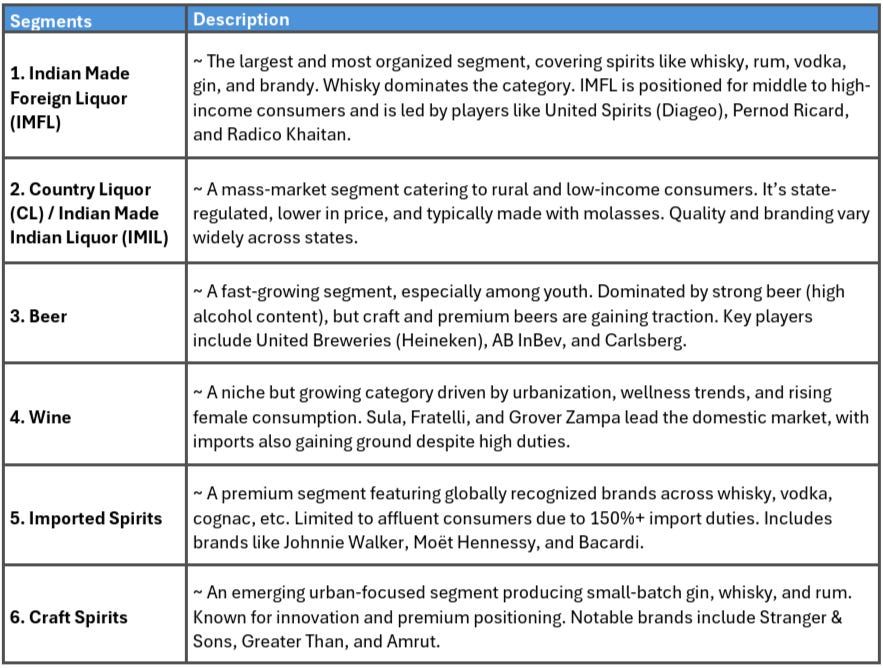
6. Key Players in the Industry
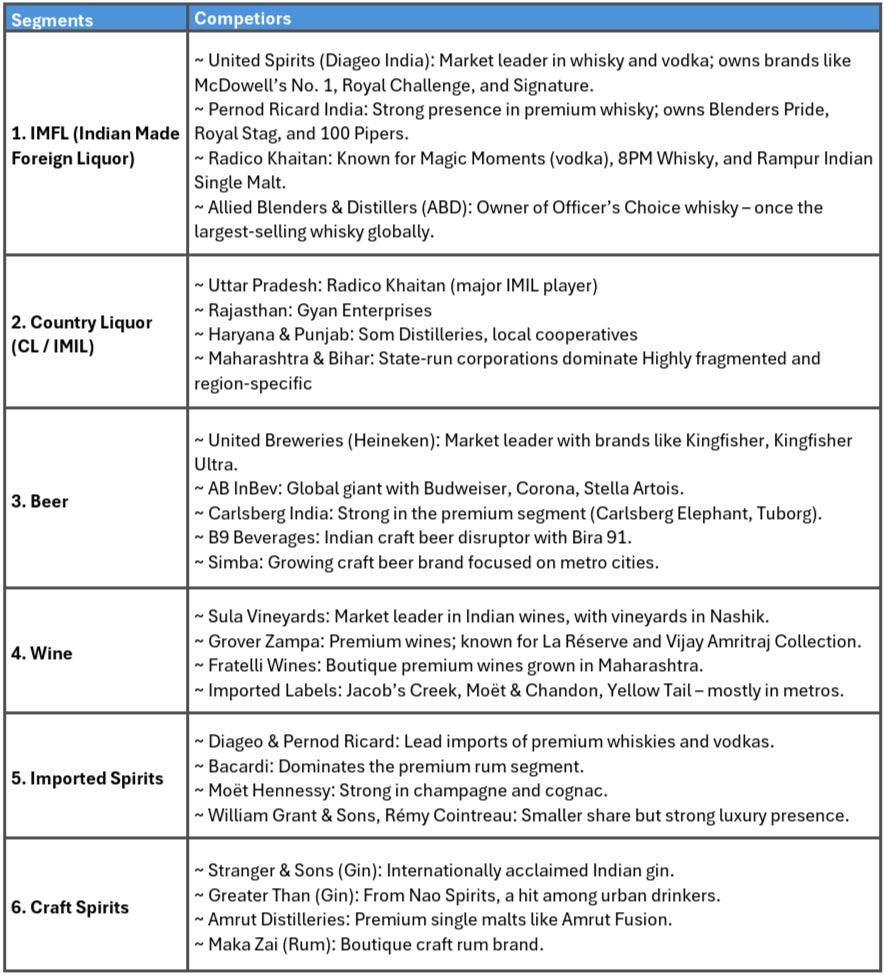
7. Growth Drivers for the Industry
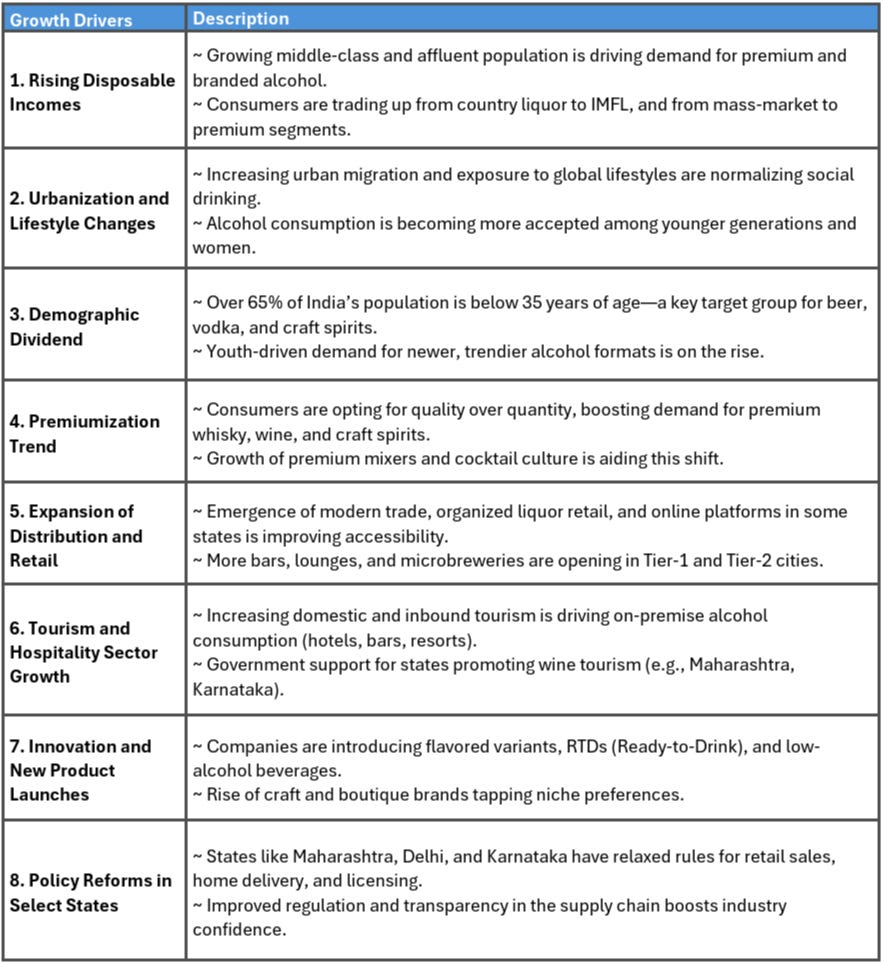
8. Challenges Being faced by the Industry
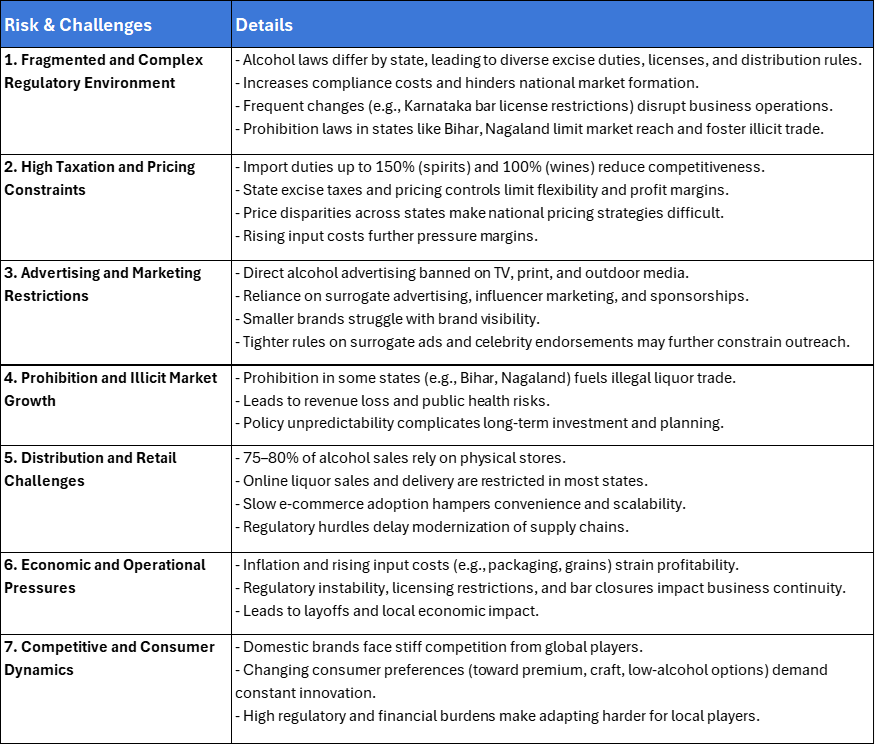
9. Outlook
9.1 Global Alcohol Industry Outlook (2025)
Premiumization Leads: Consumers are opting for higher-quality, craft, and artisanal spirits, with premium beer also experiencing growth amid a slowdown in other categories. Vinetur
Moderation Trends: There's a growing trend towards moderation, especially among younger adults, with many opting for non-alcoholic or low-alcohol beverages.
Health Warnings Impact: Countries like the U.S. and Ireland are implementing health warnings on alcohol labels, which may influence consumer behavior and industry regulations. Financial Times
E-Commerce Expansion: Online sales and direct-to-consumer models are transforming alcohol retail, with digital platforms playing a significant role in purchasing decisions. Vinetur
Sustainability Focus: Brands are adopting eco-friendly practices, including biodegradable packaging and sustainable production methods, to appeal to environmentally conscious consumers. Nedstar
9.2 India's Alcobev Sector Outlook (2025)
Revenue Growth: India's alcoholic beverages sector is projected to see up to 10% revenue growth in FY25, driven by increased consumption and premiumization. Business India News
Craft and Local Brands Rise: Microbreweries and local craft distilleries are gaining popularity, with Indian spirits carving a niche in global markets. The Financial Express
Tax Reforms: The removal of GST from Extra Neutral Alcohol (ENA) has reduced production costs, enhancing competitiveness for local players.
Home Delivery Platforms: Platforms like Swiggy and Zomato are changing how alcohol is consumed in India, offering convenience and expanding market reach.
Regulatory Challenges: High state-wise taxes and duties, along with restrictions on advertising and operational hours, continue to pose challenges for industry players.
THANKS FOR READING!!
Researched By- Naresh, Mayank and Vaibhav
All information is sourced from the company's annual reports, GoIndiastocks.in, Screener.in, industry reports and Economy Outlook reports.
We Provide More Such Industry Reports with Deeper Insights in Our Premium Services. The Customers are Happy with our Work. Reach out to us through Email to Avail them!
If you like the hard work we put in, you can invest in us:
For our Non-Indian audience: You can donate to us through PayPal. Click here.
For our Indian audience, UPI QRs are given below: